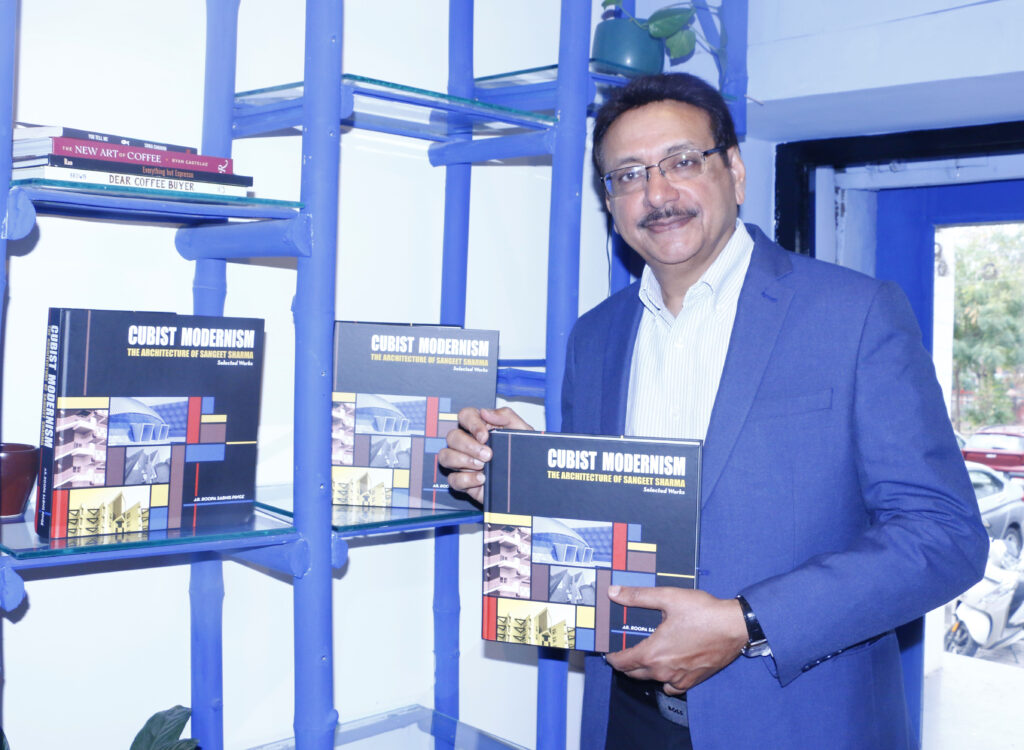
New Book Cubist Modernism –
The Architecture of Sangeet Sharma Documents a Distinct Architectural Language Emerging from the Chandigarh Modernist Legacy
Chandigarh, March 18, 2026: Architect Sangeet Sharma has released his latest book, Cubist Modernism – The Architecture of Sangeet Sharma, a reflective and visually rich publication that documents selected works from his architectural practice spanning several decades. More than a portfolio of projects, the book traces the evolution of a design philosophy that grows out of the modernist legacy of Chandigarh and extends it into what Sharma describes as “Cubist Modernism.”
Belonging to the second generation of architects shaped by the ideas that created Chandigarh, Sharma draws inspiration from the architectural vision established by Le Corbusier and the pioneering team that built the city. His father, Shivdatt Sharma, worked with Corbusier’s team, instilling in him a deep respect for clarity, proportion, structural honesty, and architectural discipline.
While acknowledging this legacy, Sharma argues that every generation must reinterpret what it inherits. The book explores how the principles of modernism—clarity of form, structural honesty, and climate-responsive design—can evolve into new expressions suited to contemporary architecture.
Through his concept of Cubist Modernism, Sharma draws parallels with the cubist movement in art, where a single viewpoint was fragmented into multiple perspectives. In architectural terms, this translates into faceted surfaces, intersecting volumes, deep shadows, and strong structural expression. Geometry in his work is not merely decorative but forms the foundation of structure, light, proportion, and spatial experience.
The book also reflects on the broader journey of an architectural practice evolving a consistent design language over decades. It highlights how meaningful architecture can emerge from regional contexts without imitation, demonstrating that modernism remains a living tradition rather than a closed chapter in architectural history.
According to Sharma, the publication carries three central messages: that modernism continues to evolve, that architectural identity develops gradually through practice and reflection rather than fashion, and that regional architectural voices can meaningfully contribute to global discourse. The book ultimately positions itself as a dialogue across generations—from the founding modernist vision of Chandigarh to a contemporary cubist reinterpretation.
About the Author
Sangeet Sharma is a Chandigarh-based architect and partner at SD Sharma & Associates, a well-known architectural practice in the region. His work, widely published in leading architecture journals in India and abroad, is recognised for its distinctive approach described as “Cubist Modernism,” deeply influenced by the architectural ethos of Chandigarh and contemporary sustainable design.
Over the course of his career, Sharma has received numerous honours and recognitions. His projects have won several awards for architectural excellence and sustainability, including the GRIHA Exemplary Performance Award for a project in Coimbatore. He has also been featured among lists such as the “Hot Hundred Architects,” the “Famous Fifty,” and the “Most Inspiring Architects of India.”
Leave a Reply